Showing posts with label ed dwight. Show all posts

Sunday, November 28, 2021

International Memorial to the Underground Railroad, Detroit MI ~ September 2021

Installed in 2001 on the Detroit River, the Gateway to Freedom sculpture was created by Ed Dwight and stands 10 x 12 feet. It depicts eight escaping slaves guided by a conductor, modeled after George DeBaptiste. George was born free in Virginia to African-American parents and as an adult moved to Indiana and helped bring escaping slaves to Kentucky. Later he moved to Detroit and assisted freedom seekers across the river to Canada (his life story is fascinating, fyi).
Historians estimate that about 45,000 escaping slaves passed through Detroit on their way to Canada, Detroit serving as one of the last terminals of the Underground Railroad.
There is a companion sculpture (Tower of Freedom) across the river in Windsor, Canada, also by Ed Dwight, that we haven't had the pleasure of visiting yet.
(Besides being a well-known sculptor, Dwight was an air force jet pilot in 1962 when President Kennedy nominated him as an astronaut trainee. Dwight would have been the first African-American astronaut. After Kennedy was assassinated in 1963, NASA dropped Dwight from the program.)
Ed Dwight has two other well-known sculptures in Michigan: Rosa Parks in Grand Rapids and an  Underground Railroad sculpture in Battle Creek.
Battle Creek
Today it's more important than ever to remember our history.
(See the link below for photos and information on the largest Underground Railroad Sculpture in the U.S.)
 

Sunday, September 5, 2021

Underground Railroad Sculpture, 256 W Van Buren, Battle Creek MI ~ May, 2021

Our first attempt to see the sculpture took place last February 😊
We returned last May and had a much better visit.
Erastus and Sarah Hussey were Quakers and abolitionists who started hiding escaping slaves in 1840. Their home became one of the main stations on the Underground Railroad in Battle Creek. Erastus and Harriet Tubman are featured on the front of the monument. There is no evidence Tubman ever set foot in Michigan but the contributions of the "Black Moses" are well-known and made her a national hero. 
One side of the monument depicts the Husseys helping escaping slaves into their home, and the details of the entire sculpture are impressive.
Harriet Tubman is shown on the other side leading slaves to their freedom.
The sculpture is 14 feet tall land 28 feet long and is the largest Underground Railroad Sculpture in the U.S. It was designed by Ed Dwight and dedicated in 1993. Besides being a well-known sculptor, Dwight was an air force jet pilot in 1962 when President Kennedy nominated him as an astronaut trainee. Dwight would have been the first African-American astronaut. After Kennedy was assassinated in 1963, NASA dropped Dwight from the program. 
Ed Dwight has two other well-known sculptures in Michigan: Rosa Parks in Grand Rapids and another Underground Railroad sculpture in Detroit.
Ed Dwight may not have made history with NASA but he's doing his part to help us remember our history.

Friday, December 3, 2010

Rosa Parks, February 4, 1913 - October 24, 2005


(Sculpture by Ed Dwight of Rosa Parks in downtown Grand Rapids Michigan)
It was December 1 of 1955 when Rosa Parks famously refused to give up her bus seat in Montgomery, Alabama. This monument to her stands in Rosa Parks Circle in Grand Rapids, Michigan.*

Parks wasn’t the first to refuse to give up her seat (look up Claudette Colvin, a 15 year old who refused to give up her seat and was arrested and jailed, 9 months before Rosa), but Parks was the one chosen by the African-American leaders in Montgomery for the lawsuit test case. The bus boycott may or may not have been spontaneous but it lasted 381 days and became a turning point in the Civil Rights Movement. At the time, Parks was working as a secretary at the local branch of the NAACP.

Some claim both events were entirely spontaneous and deny any advance planning, and others vociferously argue otherwise. Those who question the accuracy of the spontaneity claim are usually shouted down with accusations of racism in diminishing what took place. And rare mention is ever made of the earlier women who “sat down” for their rights. Their names are not known by most.

Regardless of the ultimate truth, nothing can take away from Parks’ courage in refusing to give up her seat. Just a few months before this incident, 14 year old Emmett Till was brutally mutilated and murdered for allegedly flirting with a white woman (his killers were later acquitted in a gross miscarriage of justice). Parks knew she would be arrested and she was. She was bailed out later that night and ended up becoming a symbol of the Civil Rights Movement.
(Photo from the internet)
Bus 2857, now known as the Rosa Parks Bus, can be found in the Henry Ford Museum in Dearborn, Michigan. It was retired from use in Alabama and sold in 1971. The buyer gutted it and used it for storage. It sat in his field for 30 years. When his descendants tried to sell it, the Henry Ford Museum caught wind of it and had the winning bid at auction. They restored it and visitors can now sit in the place where Rosa sat.
We visited Montgomery, Alabama in May of 2026. Rosa stands tall at the Capitol.
She has her own museum in Montgomery (252 Montgomery St) at the spot she was arrested.

Even with all of the accolades received in her lifetime, Rosa Parks' life was anything but easy. Employment became difficult for her and her husband in Alabama (Parks was fired after her arrest). They moved to Virginia in 1957 and later to Detroit, Michigan. Parks worked as a seamstress until she was hired by U.S. Representative John Conyers as a secretary/receptionist in 1965. She remained in that position until 1988. This is the duplex she lived in from 1961-1988 (3201-3203 Virginia Park St, Detroit).
Parks continued to work tirelessly for Civil Rights, donating time and money consistently throughout her later years. Our nation was treated to a sorry spectacle during the last years of her life when a lawsuit was filed on her behalf against a hip-hop group who referenced “moving to the back of the bus” in a song. Relatives decried the suit and claimed they were kept from seeing Parks. They also claimed Parks was not aware of what was taking place. Her longtime friend and caretaker proceeded with the suit that ended up being settled. Rosa Parks passed away in 2005 and was laid to rest in Woodlawn Cemetery in a chapel that is now named for her.
She had no children but left a meaningful legacy to the world of how one person can make a difference.
“I am leaving this legacy to all of you...to bring peace, justice, equality, love, and fulfillment of what our lives should be. Without vision, the people will perish, and without courage and inspiration, dreams will die - the dream of freedom and peace.”
*The sculptor, Ed Dwight, has an interesting story of his own. Back in 1962, when he was an air force jet pilot, President Kennedy nominated him as an astronaut trainee, making Dwight the first African-American ever appointed. After Kennedy was assassinated in 1963, Dwight was dropped from the program and eventually became a sculptor.
(Photo from the internet)
When I first saw this work, I questioned why she was standing up instead of sitting down. But Dwight's thought was to show Parks as emerging from her seat, becoming the quiet leader that she was. I suppose we could also say she was standing up for "the dream of freedom and peace."  May we all show as much courage today.
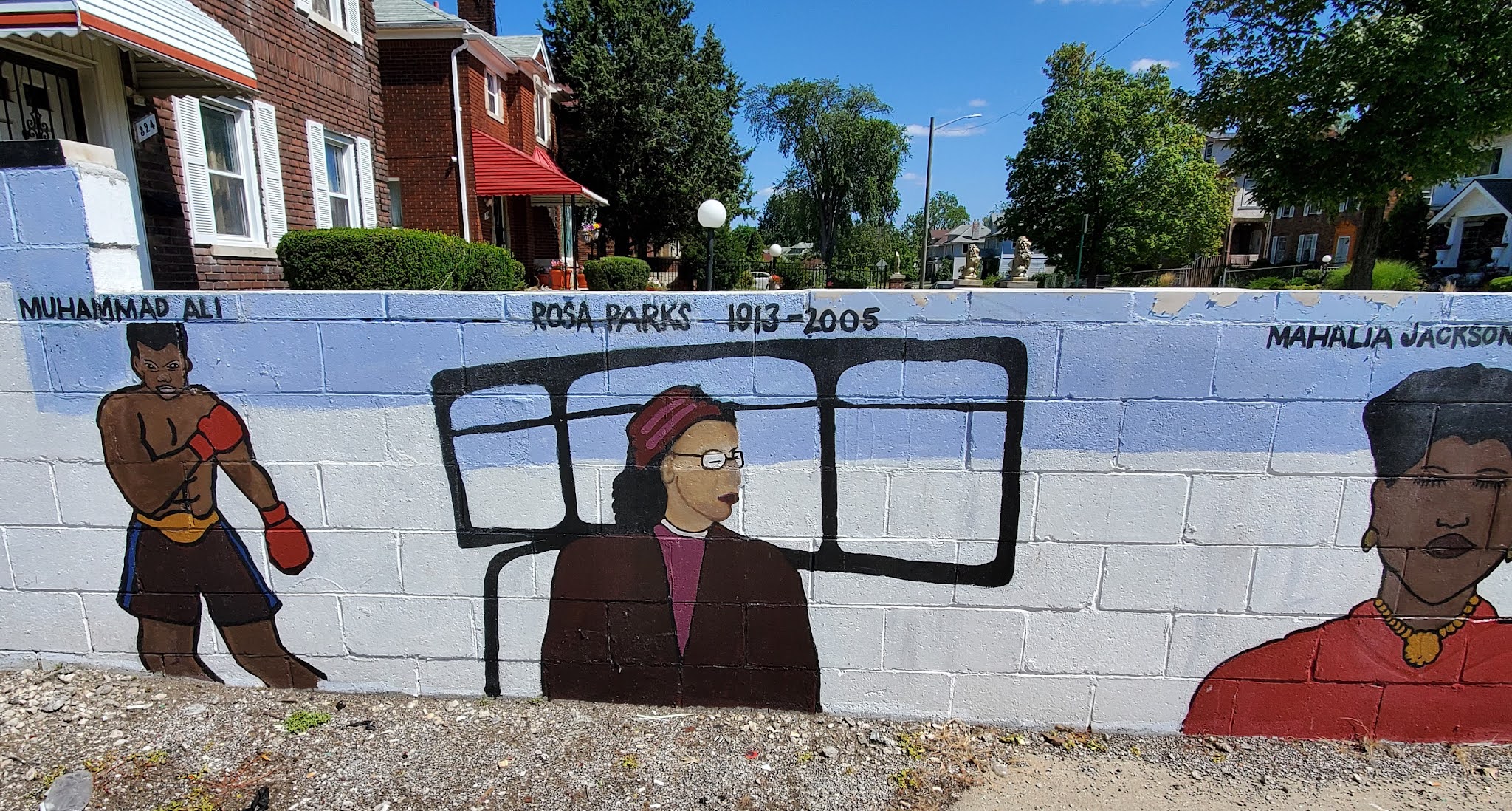
Rosa on a mural in Detroit MI
At the MLK Jr Historical Park in Atlanta, GA, Rosa is included in the Walk of Fame.